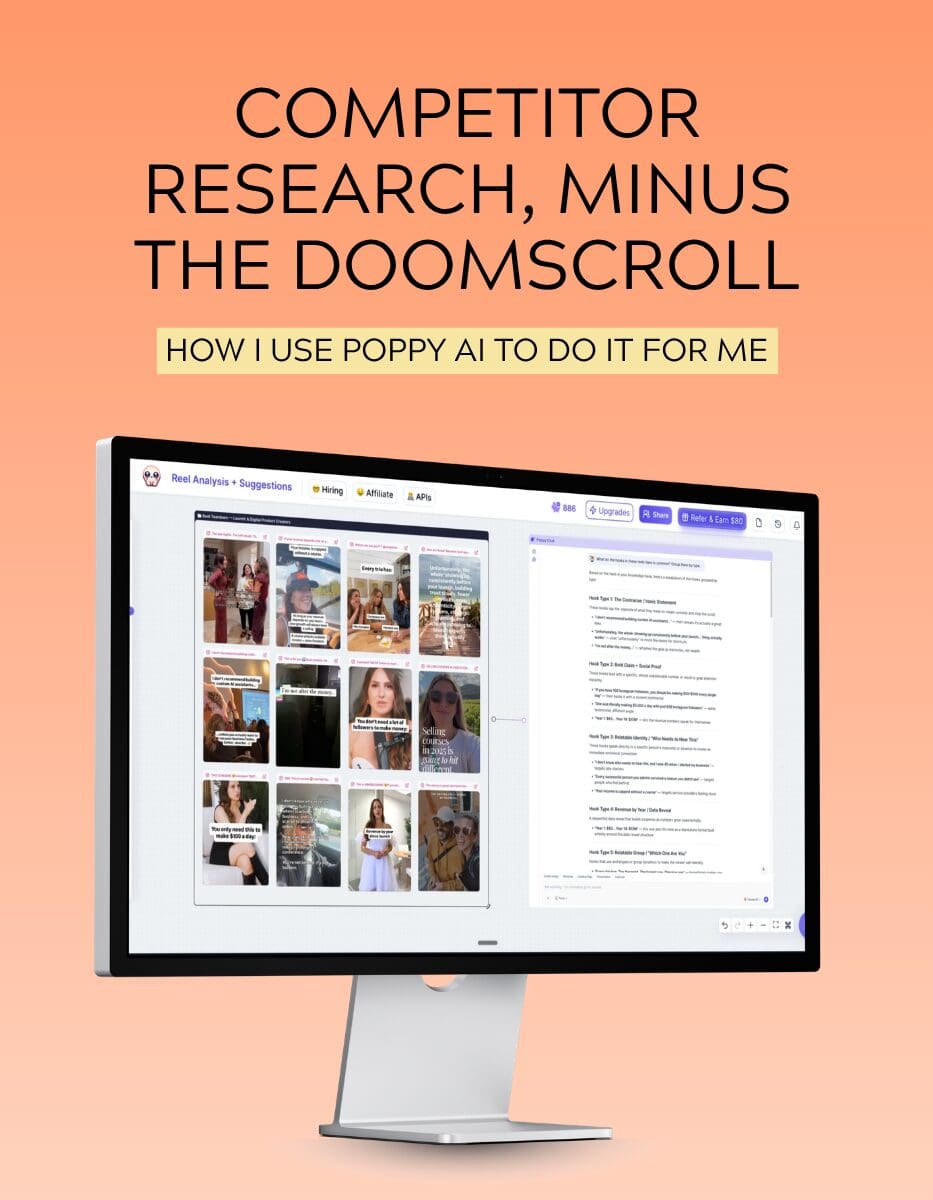

Most people research their competitors by doomscrolling and calling it work. You open Instagram to “see what’s working,” and forty minutes later you’ve watched eleven reels, liked someone’s baby announcement, fallen into a comment section, and learned nothing you can actually use on Monday.
I found a faster way, and it doesn’t involve watching a single video myself.
Last week I dropped 32 top-performing reels in my niche into a tool called Poppy AI (affiliate link) and asked it to tell me why they worked.
I didn’t watch one of them.
By the time my coffee got cold, I had a clean breakdown of the hooks, the pacing, the structure, and the patterns showing up over and over across all of them. Research that used to eat an entire afternoon took about ten minutes.
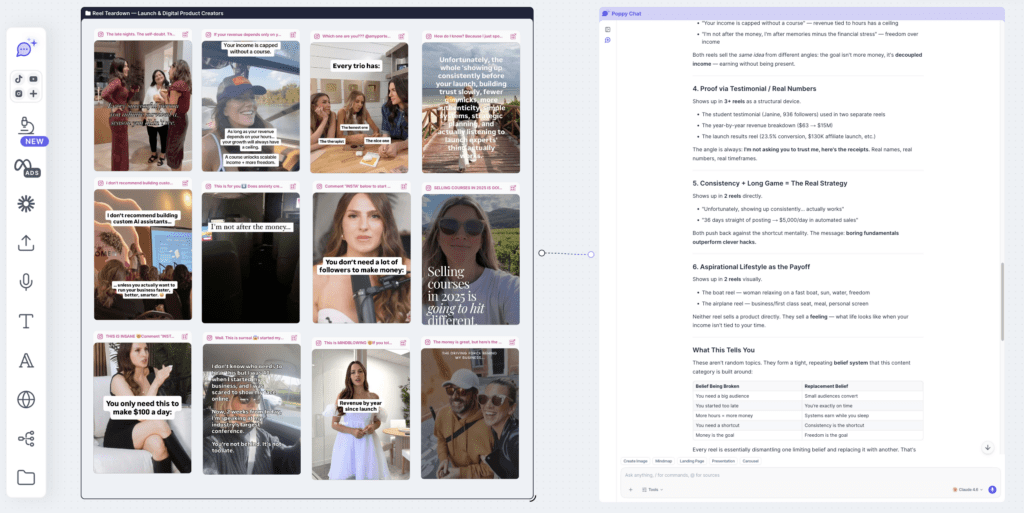
If you sell digital products, courses, templates, or memberships, this is the kind of thing that changes how you work. It moves you from “I think this is what my audience wants” to “I can see the pattern in front of me.” So let me show you exactly what it looks like.
First, what is Poppy AI?
Poppy is a visual workspace. Picture a giant digital whiteboard where you can drop in videos, reels, podcasts, PDFs, screenshots, and voice notes, and it reads and watches every bit of it for you. Then you ask it questions about everything on the board at once.
So rather than sitting through a 45-minute podcast with a notebook, you let Poppy transcribe it and hand you the parts that matter. Rather than watching 40 reels and trying to figure out what made them perform so well, you let it watch them and show you the patterns.
It runs on the major AI models, the same ChatGPT and Claude ones you already know, so there’s nothing clunky or off-brand to learn. You’re just doing your research somewhere that can actually see and hear video. That one capability is what most AI tools still can’t do, and it’s the reason this whole thing works.
Usage #1: The competitor reel teardown
Here’s the full workflow, start to finish.
Open a fresh board. Go find the top 30 to 40 reels in your corner of the internet. The trick is to look for outliers, the posts that pulled way more views than that account’s usual numbers. Those are the ones the algorithm rewarded for a reason, and that reason is exactly what you’re after. Grab the links and drop them all onto your board.
Then you start asking. Prompts like these do the heavy lifting:
STEAL THESE PROMPTS
- “What do the hooks in these reels have in common? Group them by type.”
- “Which of these first lines would stop someone mid-scroll, and why?”
- “What topics or angles show up more than once across all of these?”
- “Based on these, what structure should I use for a reel tomorrow?”
What comes back isn’t vague. It’s a real read on the pattern. Sometimes every top reel opens with a number or a flat-out bold claim. Other times the standout move is giving away the payoff in the first two seconds instead of saving it for the end. Often the topic winning in your niche this month is one you haven’t touched once.
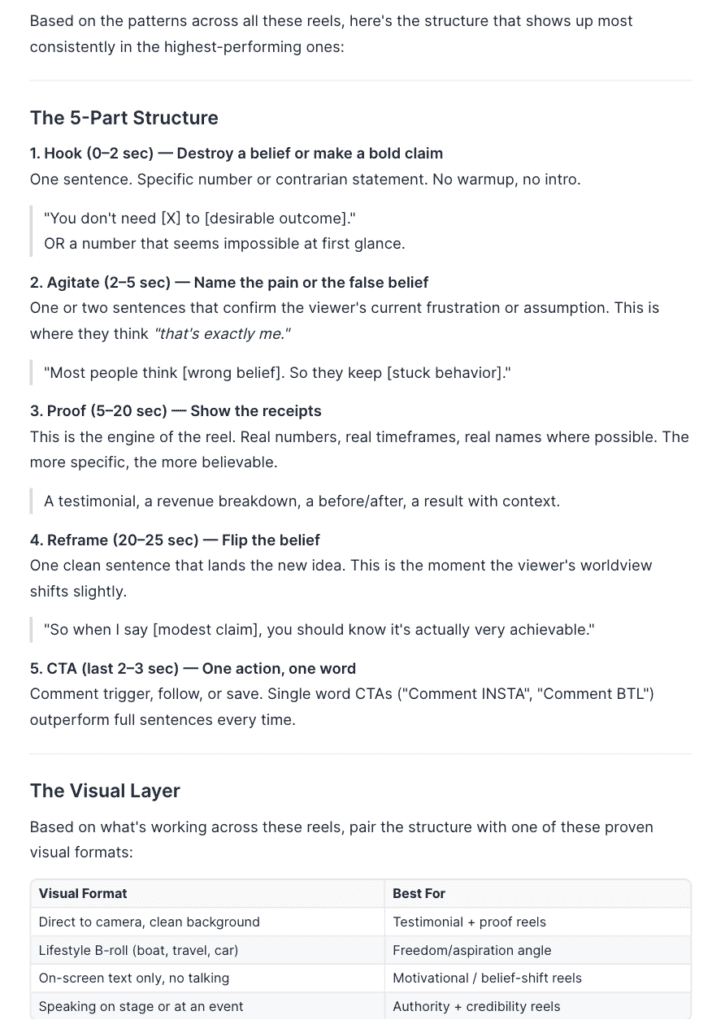
You’re not copying anyone here. You’re seeing patterns that show what works so you can put your own idea, voice, and offer into a structure that’s already proven to work. That’s the gap between throwing spaghetti at the wall and following a recipe you reverse-engineered yourself.
And it’ isn’t’s not only for video. Take a stack of YouTube thumbnails from channels that are winning in your space, screenshot them, drop them onto a board, and ask what they share visually.
Poppy will spot the color choices, the face placement, the three-word title structure you’ve been missing. Same move, different format. Poppy reads images as easily as it watches video, which means you can run this on anything your competitors put in front of people.
Usage #2: Mine your own winners
This is the one almost nobody thinks to run, and it might beat the first.
Before you study anybody else, study yourself.
Pull your best-performing content from the last year. Your top three emails by open rate, your most-saved carousel, the two reels that actually did numbers, the post that drove the most sign-ups. Drop the whole pile onto a board and ask Poppy what they have in common.
You already have proof of what your audience responds to. The problem is that it’s scattered across six platforms, two analytics dashboards, and your own short memory. Poppy lets you put it in one place and finds the commonalities you can’t see from the inside, because you’re too close to it.
Your best work might lean a little contrarian. It could always be the behind-the-scenes peek rather than the polished tip.
Once you can name your own winning pattern, you stop rebuilding your content from scratch every week and start creating more of the content that’s already working for you.
That alone is worth the price of admission for most people, because guessing is the most expensive thing you can do with your time.
Bonus play: turn one long video into a month of posts
While you’re in there, one more.
Drop a single one of your long podcast episodes, webinars, or YouTube videos onto a board and ask Poppy to pull every quotable line, content idea, and hook worth reusing. One 45-minute video can hand you a couple of weeks of carousels, captions, and email angles, and you never have to scrub back through it hunting for the good parts.
For anyone building digital products, that’s the part that pays off big time. Research and repurposing are usually where the hours vanish. Hand both of those jobs to a tool and you free up the time for the work only you can do, which is the actual creating and selling.
“But I’m not a tech person”
Fair concern. The learning curve, though, is short. If you’ve used Canva or dragged sticky notes around a screen, you can use Poppy.
Also, Poppy isn’t the cheapest thing in your stack, although this lifetime deal of Poppy AI on AppSumo is pretty damn sweet.
Poppy runs on credits, and if you go in and experiment wildly on day one, you’ll watch them drain faster than you’d like. This is worth knowing before you start. I use Opus 4.6 for most things and it doesn’t drain my credits so quickly… for instance, the examples shown on this blog used 14 credits.
When you think of the hours you currently lose consuming content just to figure out what to make, it ends up being worth it. For most of us, that consuming is the bottleneck, and it goes unnoticed because it feels like work.
A few questions you might have
Is this just ChatGPT with extra steps? No. Poppy watches video, hears audio, and sees images, and it holds everything on one visual board at the same time. Plain ChatGPT can’t sit through 40 reels and find the pattern across all of them. That capability is the entire reason to use it.
Do I have to watch the reels before I add them? You don’t. You add the links or files, and Poppy does the watching and transcribing. You go refill your coffee.
How many reels should I drop in? Enough to see a pattern repeat. Twenty is a decent start. Forty is better, because by then the repeated moves become impossible to miss.
Will this make my content sound like everyone else’s? Only if you copy instead of translate. A pattern tells you what structure tends to work. Your story, your voice, and your offer stay yours. Treat the pattern as the skeleton, never the skin.
Is it worth it if I’m just getting started? If you don’t have an offer selling yet, probably hold off. If you’ve already got something converting and you’re trying to grow without drowning in research, this is exactly the kind of tool that earns its place.
Want exclusive lifetime access?
If you’re ready to stop doomscrolling in the name of research, this is the first tool I’d point you to.
Get your Lifetime Access to Poppy AI here ← affiliate link
Drop in your competitors’ best reels. Drop in your own top performers. Let Poppy find the patterns that are already working, then go make the thing only you can make.


Comments +
Comments